What the Karnak Ticket Covers
Karnak is not one temple but a complex of temples, and the standard ticket opens
the Temple of Amun and the Open Air Museum for EGP 600 for a foreign adult, EGP 300 for a foreign student. Egypt’s Ministry of Tourism and Antiquities describes Karnak as several precincts: Amun at the center, Mut to the south, Montu to the north, and Akhenaten’s temple to the Aten to the east.
The Temple of Mut has its own ticket, EGP 200, and the evening Sound and Light Show is sold separately in dollars. Ticket offices at Egypt’s archaeological sites take cards, so plan to pay by card rather than cash.
❓ What does the Karnak ticket include?
The standard Karnak ticket, EGP 600 for a foreign adult and EGP 300 for a student, covers the Temple of Amun, the main complex most visitors mean by Karnak, and the Open Air Museum inside it. The Temple of Mut needs a separate EGP 200 ticket, and the evening Sound and Light Show is a separate $20 ticket.
The trade-off: the main ticket covers what nearly everyone comes for. Mut is a separate enclosure, worth the extra EGP 200 only if you have time left after the Temple of Amun.
What to See at Karnak, in Walking Order
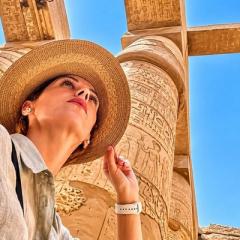
The building to plan around is the Great Hypostyle Hall, a forest of 134 columns standing 15 meters high, with the twelve central columns rising to 21 meters. The ministry dates most of its construction and all of its decoration to Seti I and his son Ramesses II, around 1294 to 1213 BC.
From the hall, the main east–west axis leads past the obelisk of Hatshepsut, almost 30 meters tall and over 300 tons, to the Akh-menu, the temple Thutmose III built at the eastern end for the gods, his royal predecessors and his own cult. The sacred lake, where priests purified themselves before rituals, can still be seen today. The temples of Khonsu and Opet sit in the southwest corner of the Amun enclosure and are part of the same ticket.
| 📍 Stop | What you see | Why it matters |
|---|
| 🟢 Great Hypostyle Hall | 134 columns, the central twelve 21 meters tall | The centerpiece of the Temple of Amun, built and decorated mostly under Seti I and Ramesses II |
| 🟢 Hatshepsut’s obelisk | Almost 30 meters of granite, over 300 tons | The larger of the two obelisks near the hall, raised by the queen who ruled as king |
| 🟡 Akh-menu of Thutmose III | A temple for the gods, his predecessors and his own cult | At the far eastern end of the main axis |
| 🟡 Sacred lake | The pool where priests purified themselves | A pause in the open after the halls |
| 🟡 Temples of Khonsu and Opet | Two smaller temples in the southwest corner | Included in the same ticket |
| 💵 Temple of Mut | A separate enclosure to the south | Needs its own EGP 200 ticket |
Karnak also has a second, north–south axis that points to Luxor Temple, 3 kilometers away. The two were linked by a processional road lined with sphinxes and ram-headed statues, used once a year for the Opet Festival, when the statues of Amun, Mut and Khonsu were carried from Karnak to Luxor Temple.
❓ What is the most important thing to see at Karnak?
The Great Hypostyle Hall in the Temple of Amun: 134 sandstone columns, 15 meters tall, with the central twelve reaching 21 meters. It was built and decorated mostly under Seti I and Ramesses II. Nearby stands Hatshepsut’s obelisk, almost 30 meters tall.
How Long to Spend at Karnak, and When to Go
Guided East Bank tours fit Karnak and Luxor Temple together into three to five hours, and Karnak, the larger of the two by far, takes the bigger share. Building over two thousand years, from Intef II to the Ptolemies, left more temples than one morning can read in detail, so decide before you go whether you want the main axis or the corners too.
Go at opening time. Karnak opens at 6 am, and the official ticket platform gives the last entry as 4 pm all year, an hour before the 5 pm closing listed by the ministry. A late start loses both the cool hours and the end of the day.
❓ How long do you need at Karnak Temple?
Plan most of a morning. Guided tours that cover both Karnak and Luxor Temple take three to five hours in total, with Karnak taking the larger part. Arrive near the 6 am opening; the last entry is 4 pm.
The trade-off: an early start gives you the coolest air and the emptiest hall; it also means leaving the hotel before breakfast, and if you arrive after 4 pm you will not get in at all.
The Karnak Sound and Light Show
The Sound and Light Show is the way to see Karnak after dark, since the temple’s day hours end at 5 pm. The show company lists a 7 pm show in English and an 8 pm show in other languages and Arabic, with ten languages in all, at $20 for an adult and $11 for a child aged 6 to 12.
Two details matter when booking. The second show runs only with at least five foreign visitors, and the company notes that dates are subject to change. The ticket is separate from the daytime entry, so the show adds to a morning visit rather than replacing it.
❓ How much is the Karnak Sound and Light Show?
$20 for an adult and $11 for a child aged 6 to 12, according to the show operator. It runs nightly, with an English show at 7 pm and an 8 pm show in other languages and Arabic. The second show needs at least five foreign visitors, and dates can change.
The trade-off: the show gives you Karnak lit at night and narrated, which the day ticket cannot; it is a scripted show rather than a free walk, and its time slot competes with Luxor Temple, which closes at 8 pm.
Luxor Temple: The Evening Half of the Pair
Luxor Temple is the natural pair to Karnak, and its hours make the plan for you: last entry at 7 pm, closing at 8 pm, at EGP 500 for a foreign adult. Do Karnak in the morning and Luxor Temple in the late afternoon, as the light drops.
| 🏛️ Karnak | 🌙 Luxor Temple |
|---|
| 💵 Foreign adult | EGP 600 | EGP 500 |
| 🕘 Hours | From 6 am, last entry 4 pm | From 6 am, last entry 7 pm, closes 8 pm |
| Scale | A complex of precincts and temples | One temple, walked end to end |
| Best time | ✅ Opening hour | ✅ Late afternoon into dusk |
| After dark | ⚠️ Only with the Sound and Light Show ticket | ✅ Open until 8 pm on the regular ticket |
The core of the temple was built by Amenhotep III, and its Great Colonnade of fourteen columns was decorated under Tutankhamun and Horemheb with scenes of the Opet Festival. Ramesses II added the front pylon and two 25-meter obelisks; one still stands, and the other has been in the Place de la Concorde in Paris since 1836. Inside, the Romans turned one room into the sanctuary of their fort in the late third century and painted it with the emperor Diocletian and his co-rulers, paintings that are now being restored.
The avenue of sphinxes runs 2.7 kilometers from Luxor Temple toward Karnak and was reopened with a ceremony in November 2021.
❓ Should you visit Karnak or Luxor Temple first?
Karnak first, in the morning, and Luxor Temple in the late afternoon. Karnak’s last entry is 4 pm, while Luxor Temple stays open until 8 pm with last entry at 7 pm, so the order follows the hours. Tickets are EGP 600 and EGP 500 for foreign adults.
The trade-off: splitting the pair across the day gives each temple its best hour; it also means two trips to the East Bank sites instead of one, which a half-day tour will not do.
Karnak With a Guide or on Your Own
Most East Bank tours pair Karnak with Luxor Temple in a half day, with hotel pickup. Entry tickets are often not in the tour price, so read the Includes section before comparing two tours, and expect to pay EGP 1,100 per adult for the two temples if they are not included.
What a guide adds at Karnak is order: which king built which court, what the scenes on a wall record, where the axis turns. What you gain alone is timing, the 6 am opening and the choice to stay in the hall as long as you want.
❓ Are Karnak tickets included in tours?
Sometimes. Some East Bank tours include the Karnak and Luxor Temple tickets and others leave them to you; each tour lists this in its Includes section. Without tickets included, the two temples cost EGP 1,100 for a foreign adult, paid by card at the gate.
The trade-off: a guide turns the columns into a story and handles the transport; the tour also sets your hours, and Karnak at opening time is something you may have to arrange yourself.
Ticket prices, hours and the history of the temples are as published by Egypt’s Ministry of Tourism and Antiquities on its website and official ticketing platform, checked in November 2026. Show times and prices are those listed by the Sound and Light Show operator. Prices, opening hours, show schedules and payment rules can change. Confirm at the ticket office before you visit.